At Birkerød Gymnasium collaboration and community go hand in hand
The collaborative education project at Birkerød Gymnasium promotes integration between students from the IB, STX, and HF programmes. Through shared activities and teaching, curiosity and understanding are fostered, strengthening identity and community in an environment that values diversity and mutual respect.
We are sitting in the small, cozy meeting room with the new posters on the walls, and I have just asked Selma and Hakan what it is like to attend a school that offers IB, STX, and HF.
“I think it has a lot to do with the fact that it’s all at the same school. So even though they are different programmes, they don’t really feel that foreign after all. You see each other around, and I actually thought that was really great,” says Selma, and Hakan agrees: “IB and STX were basically just the same building. And it was also local for me here in Birkerød. It also shows how much BG accepts different people for who they are.”
And Selma and Hakan know particularly well what they are talking about. They are twins, they have Turkish roots but were born and raised in Denmark, they attended a regular local public school, and they both graduated from Birkerød Gymnasium in 2025 – Selma from STX and Hakan from IB. For Selma, choosing STX after lower secondary school felt like the natural path, while for Hakan, it was about trying something new and international, challenging himself, and fulfilling childhood dreams of wearing a graduation cap decorated with beautiful flags.
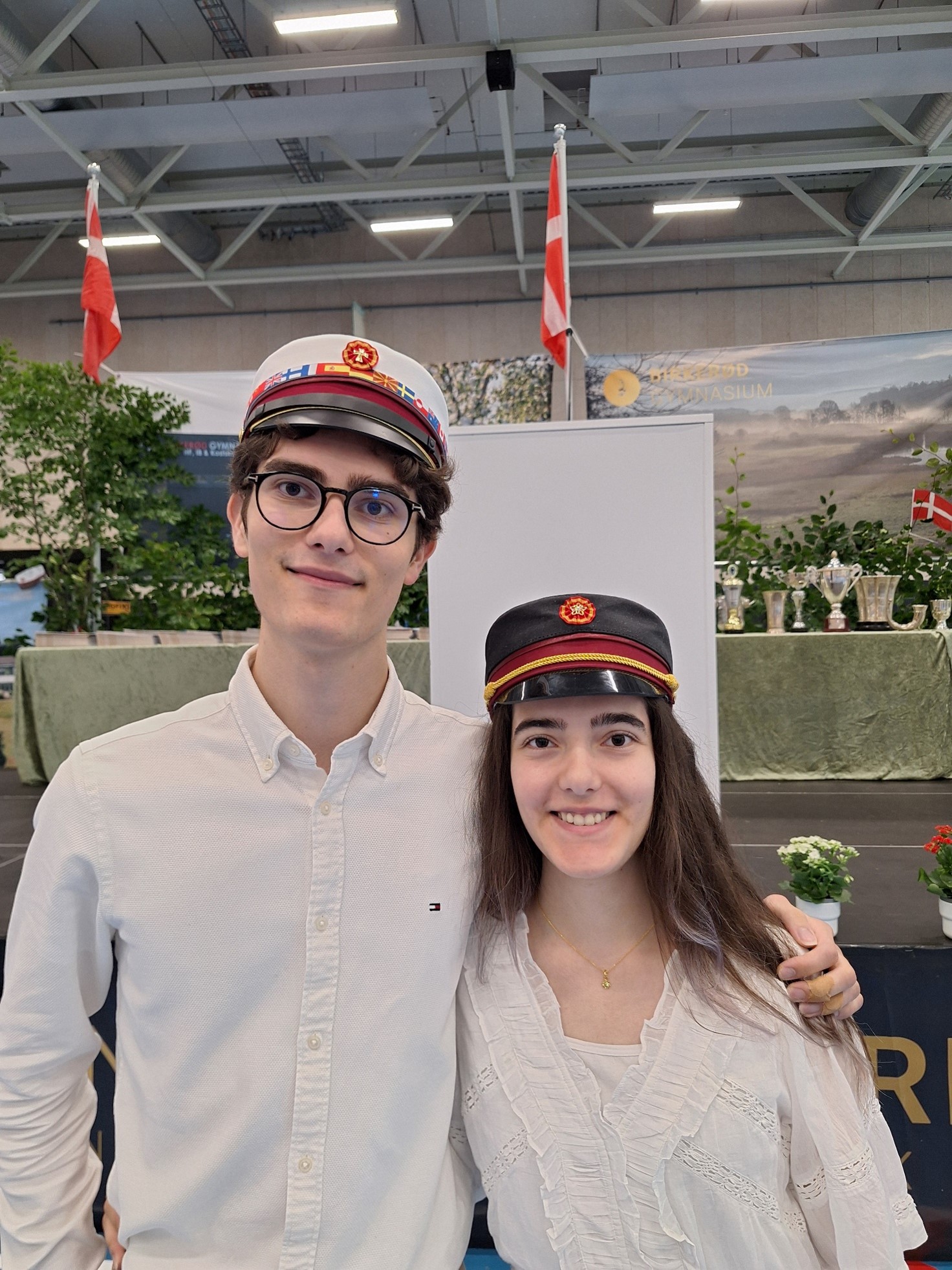
This acceptance of each other’s differences across the different programmes lies at the heart of the collaborative education project at Birkerød Gymnasium. The project is possible because, as Selma and Hakan explain, we have everything under the same roof. We are not a campus with separate schools; we are one school with three different systems, sharing the same classrooms, buying food from the same cafeteria, partying together, and graduating together. This creates a very special atmosphere and offers very special opportunities.
It also creates very particular challenges. It is natural to define oneself in contrast to people who do things differently – especially when you are young. In that sense, being different is important. It is part of the separate identities of STX, HF, and IB students. There must be room for that, and it must be protected. We have separate traditions within the three systems precisely to ensure the sense of security that comes from being among people like yourself. But when I ask Selma and Hakan whether this also creates prejudice, the answer is unequivocal. Everyone has stereotypes about the other systems. According to Hakan, it is a bit like the relationship between people from Jutland and Zealand – a “love-hate relationship.” Selma points to the image of IB as involving larger workloads, discipline, and constant exams, while Hakan would like to see more of the STX-style groupwork in the IB. On the other hand, they both agree that the STX Study Project places far greater demands on students in every respect than the IB Extended Essay.
The same applies socially. As Hakan says about IB: “I got to know more people and had a bigger social environment, whereas STX felt more connected to your own class. But of course, you still know people from other classes too – it’s just that your lovely class becomes the core.” And Selma agrees: the broader environment is exciting, but she still prefers the secure foundation of the homeroom class in STX. In this way, the two of them perfectly illustrate how they define themselves in relation to one another, and how both differences and similarities have shaped their identities as students. But because they also share each other’s experiences, what for many people would remain stereotypes instead becomes an experience of difference that sparks curiosity.
This demonstrates with complete clarity something crucial about the idea of collaboration at Birkerød Gymnasium, HF, and IB: having multiple programmes under one roof is a gift, but it is not enough simply to share the same roof. If difference is not to become a barrier, but instead a foundation for identity formation and community, then it must be discussed positively and cultivated in practice. For Selma and Hakan, this comes naturally. They meet as siblings, and through them their friends meet as well. “I can definitely remember your friends coming up to me and saying, ‘Hey, you’re Hakan’s sister,’ and then we would just start talking. I actually think that may have helped break down some stereotypes about who you are when you attend different programmes.” Hakan shares the same experience: “‘You’re her brother – is she in IB?’ ‘No, she’s in STX.’ ‘Oh wow, really? What’s her name?’ I think when you know someone, then you also get to know people from both sides, and you learn to understand things better.” These are the kinds of everyday encounters generated by the collaborative education project. Academically, all students will at some point during their education participate in collaborative teaching across different subjects, where STX, HF, and IB students meet through shared academic work. Dedicated teachers plan joint modules where students discover that although there are different traditions regarding group work and homework, there is still a common academic reality they can meet around and learn from together. Socially, all students take part in the school’s major shared events such as Sports Day, Friday cafés, and parties. Likewise, all students begin the school year with a large speed-dating event, where together with their classmates they meet students from different programmes, year groups, and study tracks. This creates many small encounters that give students the opportunity to meet others who, like themselves, have just started at BG, but who come from different backgrounds and interests.
“It’s just really cozy, and I love all the clubs we have and all the activities the school organizes, because we come together, have fun, and meet new people. I get so sad every time it ends.” That is how Hakan describes the many activities available at BG once the fourth lesson of the day is over. Selma agrees: “When I signed up for it, there were IB students everywhere. And honestly, I thought that was really cool.”
These many clubs and activities are at the heart of the school’s collaborative education project, extending beyond the ordinary framework of the school day. Here, students create their own meeting places. Coordinated through a shared app, BG Connect, they create clubs that they themselves are responsible for running, and, almost like shopping online, students buy into each other’s ideas and sign up for knitting club, investment club, programming club, sustainable fashion club, film club, football, and much more. In the same way, teachers can create activities and give students opportunities to share experiences and learning in, for example, the creative writing club, the creative gardening club, the chess club, or the Red Cross team.
This is structurally supported through the requirement for student hours in STX and HF, as well as CAS points in IB. Engagement is part of the fundamental premise of these programmes. But it works because passionate students and teachers create energy and joy in every single club. As Hakan says: “I was genuinely motivated to join Red Cross, the musical, BIGMUN, cake sales – whatever you could do at BG, man, I joined everything.” The musical in particular has proven to be a meeting place where all three programmes become involved and, for a moment, forget their stereotypes in a shared creative project. And it is that moment that matters. The goal is not to erase differences completely, nor is the ambition for everyone to become lifelong best friends. The goal is for everyone to experience moments of positive encounters – moments where you are simply teenagers and BG students together.
We give the final word to Selma and Hakan before they move on into the world. Selma: “It’s really great that there are all these different environments. People clearly come from very different backgrounds if you look at the international programme, STX, or HF, so there are really… all kinds of people. And I honestly think that’s amazing. You get to know all sorts of people.”
Hakan: “Yeah, I was also happy to meet both STX students, IB students, and some HF students. I remember thinking, WOW, this is really nice – I hope this continues at BG. It was such a great experience.”
Stine Helth, Collaborative Education Coordinator.